
The Silent Force That Keeps Humanity Moving Forward
There comes a moment in many lives when the old definitions of success stop making sense. The pursuit that once appeared clear becomes blurred by exhaustion, responsibility, uncertainty and the quiet pressure of expectation. We continue moving forward, not always because we are certain of where we are going, but because stopping feels impossible. Sometimes we are driven by ambition. Sometimes by fear. Sometimes simply by the awareness that other people are depending on us, that our choices ripple outward into lives beyond our own. And so we keep running, hoping that somewhere ahead the fragments of effort, sacrifice and struggle will eventually assemble themselves into meaning.
Yet perhaps meaning does not arrive at the end of the journey. Perhaps meaning emerges through the act of becoming itself.
Human beings have always searched for permanence in a universe that is fundamentally fluid. We try to build stable identities, stable careers, stable systems and stable societies, yet everything around us reveals a different truth. Forests evolve. Oceans shift. Stars are born and collapse. Civilisations rise, transform and disappear. Even the cells of our bodies continuously regenerate. The deeper rhythm of existence is not stability but movement. Life is not a fixed condition; it is an unfolding process.
This is why certain words, melodies and ideas affect us so profoundly. They awaken something ancient within us: the recognition that struggle and transformation are inseparable from being alive. The most powerful forms of art do not merely entertain us; they reconnect us with the unfinished nature of existence. They remind us that growth often emerges from uncertainty, that beauty can exist inside difficulty, and that human beings are capable of enduring far more than they imagine when they possess a reason to continue.
When Technology Stops Being a Tool and Becomes an Extension of Consciousness
This insight becomes increasingly important in an age where technological acceleration is reshaping nearly every aspect of human life. Artificial intelligence, quantum computing, regenerative medicine, neuroscience, space exploration and new forms of energy are not simply isolated innovations. Together they represent the early signals of a civilisation approaching an unprecedented threshold in the history of life itself. Humanity is no longer merely observing evolution. For the first time, it is beginning to participate consciously in directing it.
And yet, despite these extraordinary advances, many individuals and organisations remain trapped inside outdated psychological and institutional models. We continue to measure success through exhaustion, productivity through disconnection and progress through extraction. Entire economic systems reward speed while neglecting meaning. We have learned how to connect devices across the planet, yet millions of people feel increasingly disconnected from themselves, from one another and from the living systems that sustain them.
This may be the central paradox of our era: humanity possesses extraordinary technological power while simultaneously suffering from a profound crisis of inner orientation.
The future therefore cannot be shaped by technology alone. It requires a transformation in consciousness, values and collective imagination.
Ancient wisdom once taught that all living beings belong to a single interconnected reality. Modern science is beginning to rediscover this truth from entirely different directions. Ecology reveals the deep interdependence of ecosystems. Neuroscience demonstrates how profoundly human emotions affect one another. Quantum physics challenges simplistic notions of separation. Complexity theory shows that even small actions can propagate through systems in unpredictable ways.
What if the next stage of civilisation emerges not from domination over nature, but from participation within it?
The Planetary Mind: From Extraction to Symbiosis
Imagine technologies that do not extract intelligence from the living world but communicate with it. Human beings would no longer stand outside nature observing it as an object. We would participate within a living planetary network of shared awareness.
Such idea may appear speculative today, yet history repeatedly demonstrates that many of humanity’s greatest breakthroughs initially seemed impossible. Flight, space travel, quantum communication and artificial intelligence were all once dismissed as fantasy. The true limitation of civilisation has rarely been technological capability itself; it has been the boundaries of collective imagination.
The same may prove true for energy.
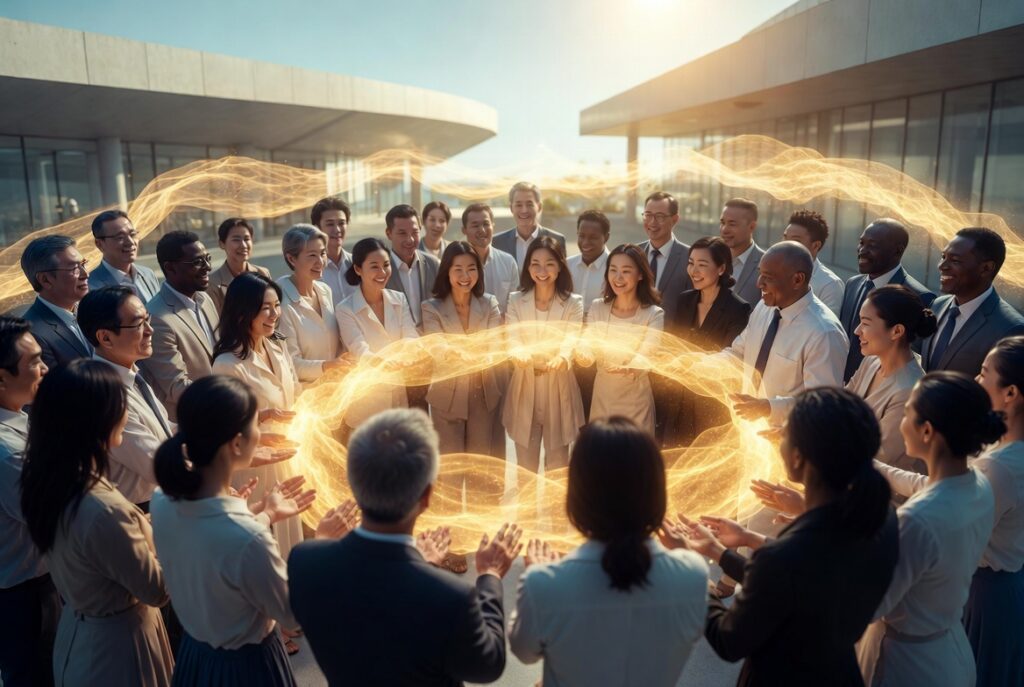
For centuries civilisation has generated power through extraction: burning, splitting, consuming and exhausting resources. But perhaps future discoveries will reveal forms of energy rooted not in destruction but in coherence. It is conceivable that human emotional synchronisation, collective resonance and harmonious biological interactions generate measurable energetic fields that science has not yet fully understood. Communities acting in genuine alignment—through movement, shared intention, music or collective emotional coherence—could potentially create stabilised resonance structures capable of producing usable forms of energy.
In such a world, energy would no longer emerge primarily from consumption but from connection.
The implications would be revolutionary. Cooperation, empathy and social harmony would cease to be merely moral ideals; they would become infrastructural forces directly linked to societal prosperity. Civilisation itself would begin reorganising around alignment rather than fragmentation.
Time Is Not a Clock: The Future as a Living Emotional Landscape
Perhaps even time, the deepest architecture of existence, will eventually be understood differently. Humanity currently experiences time as linear and irreversible, yet advances in quantum theory increasingly challenge simplistic interpretations of causality and observation. Future technologies may one day allow individuals or societies to sense probabilistic futures—not as deterministic predictions, but as emotional and ecological possibilities. Decisions could be evaluated not only intellectually but experientially, allowing communities to feel the long-term consequences of their actions before fully committing to them.
A civilisation capable of sensing the suffering generated by future ecological collapse might choose differently in the present. A civilisation capable of emotionally experiencing the beauty, intelligence and interconnected abundance of a thriving future Earth would protect life out of awe for what existence itself is capable of becoming.
Yet all these possibilities ultimately return to a simpler and more personal question: what does it mean to live fully now?
Many people spend years waiting for certainty before beginning. Waiting for confidence before acting. Waiting for permission before changing direction. Yet existence itself offers no guarantees of certainty.
“The best time to plant a tree was twenty years ago. The second-best time is now.”
The Responsibility of Conscious Evolution
This principle applies not only to individuals but also to organisations, universities, research institutions and entire societies. Institutions designed for a slower world must now evolve toward systems capable of continuous adaptation, interdisciplinary collaboration and ethical imagination. Innovation can no longer remain confined to isolated departments or treated as a temporary strategic initiative. It must become part of the living architecture of organisations themselves.
This is precisely why organisations such as Grateo become increasingly important in the emerging landscape of transformation. In an era where technological, financial, biological and cognitive revolutions converge simultaneously, institutions require more than technical consulting. They require frameworks capable of integrating strategy, artificial intelligence, financial intelligence, organisational design and human creativity into coherent systems of evolution. The challenge is no longer simply adopting innovation, but learning how to think, decide and evolve differently.
Because the future will not be shaped only by the most advanced technologies. It will be shaped by the emotional maturity, ethical intelligence and collective imagination guiding those technologies.
And perhaps this is the deepest responsibility of our generation.
Not merely to innovate faster.
Not merely to accumulate more knowledge.
But to evolve consciously.
To recognise that every action, every institution, every technology and every idea contributes to the living architecture of the future.
The universe itself appears driven toward increasing complexity, awareness and interconnectedness. Human beings are not separate from this process. Every discovery expands the horizon of possibility. Every act of compassion strengthens the invisible fabric connecting life. Every courageous idea becomes a seed for futures that do not yet exist.
Your greatest responsibility is therefore not to impress the world. It is to awaken the fullest version of yourself and contribute that awakening to the evolution of life itself.
Because perhaps the meaning we are searching for does not exist somewhere ahead waiting to be discovered. Perhaps meaning is created every time a human being chooses growth instead of fear, imagination instead of resignation and connection instead of indifference. We need to get excited again. We all have an incredible, healing and meaningful journey in store for us.
And perhaps the most beautiful truth of all is this: we are not merely witnesses to evolution. We are participants in it.