
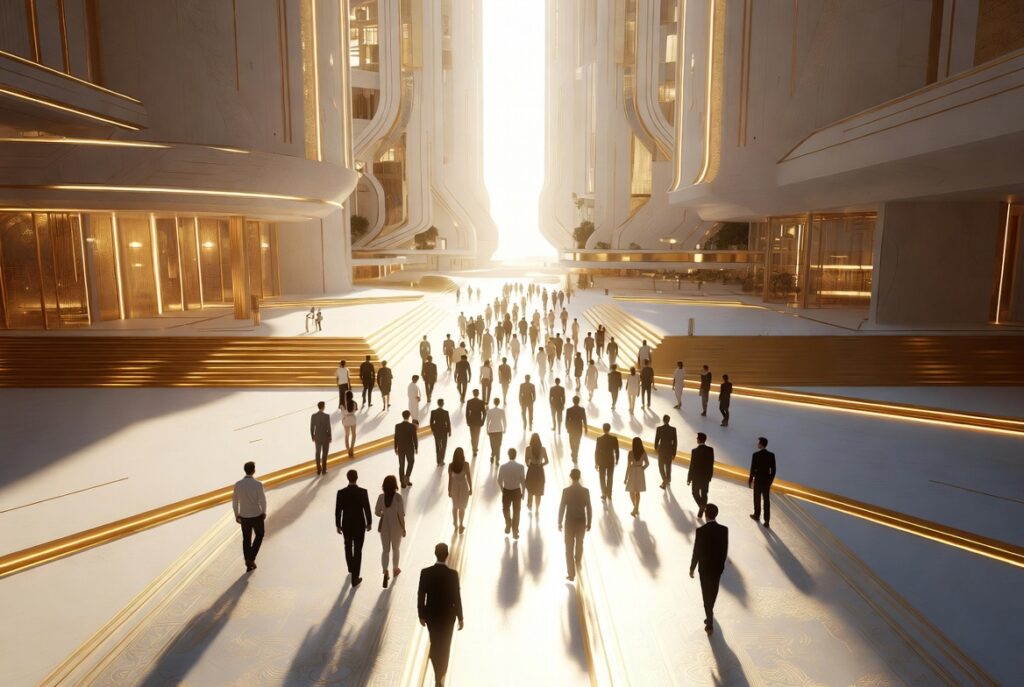
Change is often described as something that happens at certain moments—periods of crisis, innovation or historical transition when the world suddenly seems to accelerate. Yet the deeper truth is that change is not episodic but constant. The universe itself is an unfolding process, a continuous transformation in which stars are born, ecosystems evolve, ideas emerge and societies reinvent themselves. Life derives much of its meaning precisely from this perpetual movement. The beauty of existence lies not in permanence but in becoming: in the endless capacity of individuals, communities and civilisations to explore new possibilities, to grow beyond their previous limits and to participate consciously in the ongoing evolution of the world around them.
Music has long captured this sensation of transformation. Across cultures and generations, certain melodies resonate because they evoke the feeling of awakening after a period of stillness, of rediscovering energy and direction after uncertainty. Such compositions do more than entertain; they remind us that renewal is woven into the fabric of life itself. The rhythm of music mirrors the rhythm of transformation: tension giving way to release, hesitation giving way to movement, silence giving way to new expression. In this sense, artistic creation often anticipates intellectual or technological change, revealing through emotion what societies will later recognise through science and innovation—that progress begins with a willingness to embrace transformation.
Human history is filled with periods of profound change, yet what we are experiencing today goes far beyond the scale of previous revolutions. The agricultural, scientific and industrial transformations each reshaped civilisation, but they unfolded over centuries and largely affected specific domains of human activity. The transformation now underway is fundamentally different. For the first time in the history of life on Earth, multiple dimensions of progress—scientific, technological, biological, cognitive and cosmic—are advancing simultaneously and interacting with one another in real time. Artificial intelligence amplifies scientific discovery; global networks connect billions of minds; biotechnology reshapes our understanding of life space exploration extends human curiosity beyond our planet. This convergence creates a dynamic unlike anything that has existed before.
One of the most striking examples of this unprecedented transformation emerges from the rapidly expanding field of neuroscience. For centuries the human brain was regarded as a relatively fixed organ whose capacities were largely determined early in life. Today research reveals a very different reality. The brain is extraordinarily plastic, capable of reorganising itself continuously in response to experience, learning and environment. Every discovery, every conversation and every new perspective literally reshapes the neural architecture through which we perceive the world. Understanding this adaptability fundamentally changes how we think about education, creativity and personal development. Human intelligence is not static; it is a dynamic system capable of continuous expansion. At the same time, advances in physics are transforming our understanding of the universe itself. Quantum theory reveals a reality far more complex and subtle than classical models once suggested, where particles exist in states of probability and where observation influences physical outcomes. Quantum computing promises computational capacities that could allow us to simulate molecular processes, design revolutionary materials and solve problems that are currently beyond the reach of classical machines. These discoveries remind us that the boundaries of knowledge are far from fixed; they expand whenever curiosity challenges established assumptions.
Medicine is undergoing an equally extraordinary transformation. Regenerative therapies aim not merely to treat disease but to restore tissues and organs, potentially redefining the limits of human health and longevity. Advances in genomics, personalised medicine and bioengineering are opening pathways toward healing that were inconceivable only a generation ago. In parallel, new research into microbiomes and biological ecosystems reveals that human health is inseparable from the health of the broader biological environment in which we live. Beyond Earth, humanity is entering a new era of exploration. Advances in propulsion technologies, robotics and private aerospace initiatives are accelerating our ability to explore the Moon, Mars and the deeper regions of our solar system. These efforts are not merely technological achievements; they represent an expansion of human perspective. Looking outward toward the cosmos inevitably invites us to reflect inward on the fragility and uniqueness of life on our own planet.
Energy—perhaps the most fundamental driver of civilisation—is also approaching a period of radical transformation. Renewable systems and the long-sought potential of nuclear fusion promise cleaner and more abundant sources of power. Yet it is equally possible that the future of energy will emerge from discoveries we have not yet imagined. Humanity may one day learn to harness gravitational interactions, tap into energy fields associated with cosmic phenomena or uncover entirely new physical principles that redefine how energy is generated and transmitted. What once seemed speculative often becomes tomorrow’s scientific frontier. The history of science repeatedly demonstrates that the universe contains far more possibilities than any generation initially perceives.
Amid these extraordinary developments, artificial intelligence is emerging not simply as a tool but as a catalyst for accelerating discovery across nearly every field. When combined with human creativity and judgment, intelligent systems enable forms of problem-solving that were previously impossible. This evolving relationship between humans and intelligent machines is increasingly described as intelligence augmentation—a collaborative dynamic in which technology amplifies rather than replaces human capability. The most transformative breakthroughs of the coming
decades will likely arise from this symbiosis between computational power and human imagination.
Yet technological progress alone does not guarantee beneficial outcomes. The direction of evolution depends on the values that guide it. For innovation to truly enhance life on Earth, it must consider the wellbeing of all forms of life and the delicate balance of planetary ecosystems. Scientific advancement without ecological awareness can lead to unintended consequences, while technological power without ethical reflection risks amplifying inequality or instability. The challenge of our time is therefore not merely to innovate, but to innovate wisely—to design systems that enhance prosperity while preserving the conditions that allow life to flourish. This is precisely where organisations, institutions and communities play a crucial role. Corporations, universities, research centres and public institutions shape how knowledge becomes action. Yet many of these organisations were originally designed for a slower and more predictable world. Adapting to an era of constant transformation requires rethinking how disciplines interact, how decisions are made and how creativity flows across organisational structures.
Companies such as Grateo exist precisely at this intersection of transformation. Their role is not simply to provide technical expertise but to help organisations integrate strategic thinking, financial intelligence, technological capability and human creativity into coherent systems of innovation. In a world where change accelerates continuously, organisations need more than information; they need frameworks that allow them to interpret signals, connect ideas across disciplines and translate emerging possibilities into practical action. By bridging strategy, finance, artificial intelligence and organisational design, firms like Grateo help institutions transform awareness of change into the capacity to shape it.
For individuals, this transformation invites a similar shift in mindset. The pace of discovery means that learning can no longer be confined to a particular phase of life. Curiosity, adaptability and openness to new perspectives become essential qualities for navigating an evolving world. Each person participates in the broader process of societal evolution through their ideas, their collaborations and their willingness to explore new intellectual territories.
Communities also play an indispensable role in this journey. Social progress emerges not only from technological breakthroughs but from the collective actions of people who choose to build inclusive, resilient and forward-looking societies. When communities encourage education, creativity and cooperation, they create environments where innovation can flourish while remaining aligned with human and ecological wellbeing.
Seen from a wider perspective, evolution is not merely a consequence of change; it is the fundamental nature of existence itself. The universe is not static but creative. From the formation of galaxies to the emergence of consciousness, from biological
diversity to technological ingenuity, reality continuously generates new forms of complexity and possibility. Human civilisation represents one expression of this broader cosmic creativity—a moment in which the universe becomes aware of itself and capable of consciously shaping its future.
Recognising this deeper context transforms how we perceive change. Rather than something to resist, change becomes an invitation to participate in the unfolding story of life. The discoveries of science, the creativity of art, the courage of explorers and the imagination of innovators all reflect the same impulse: the desire to explore what lies beyond current understanding.
The beauty of becoming lies precisely in this infinite horizon of possibility. Every discovery expands the boundaries of knowledge; every innovation opens pathways that did not previously exist. The future therefore does not simply arrive—it is created through the curiosity, imagination and responsibility of those willing to explore it. And perhaps the most remarkable aspect of this moment in history is that humanity
possesses, for the first time, the collective knowledge and technological capability to
guide its own evolution consciously. The challenge before us is to ensure that this
evolution serves not only our own species but the entire living system of which we
are a part.